
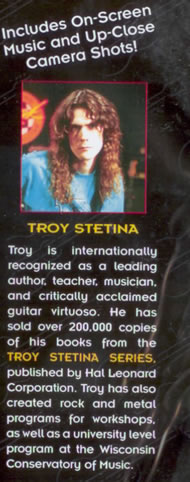
 From the E scale you change keys and try it in A and so on and on. He teaches you quite plainly how to finger these most basic voicings which incidentally sound differently but good on an acoustic guitar unplugged too. Then he explains to you how to count time or the pulse along with a drum beat but far too briefly. That could be a course in its self. In fact if you want to learn to count time drums for kids is perfect! But I digress!
From here on we are using a drum machine to accompany our example bars. Troy goes on to progressions and explains counting eight notes and the strum you should use One and two and three and four and. He brings up syncopation and how to do it with your strum by skipping and tieing notes.
Before you know it you are playing ballad spacey arpeggiated rock and then he introduces power chords which are neither major or minor and do have some subtleties to them... These voicings are implied and among the very first chords you will play but now you may play them with more authenticity and authority. Rhythmically E5, A5, G5 seamlessly segue to all downstrokes vs. alternate picking. He talks about rests, ties, and a lot more things that you will want to look at in more depth. Music is complicated there is a lot to it. We move on to chord formulas and voicings and Mixolydian mode and the E scale and what that is - but there is no book. There should be a book. He does show us diagrams we can pause and copy. We build a triad chord E major notes 1 3 5
We make a minor chord then we do A G C chords using the notes one, differentiating the third, Maj. or minor thirds and fifths G and C. We talk about Tonal Centers and twelve bar blues being the basis for lots of rock songs A Mixolydian. Here is where you wish you had a book with these scales laid out for you instead of craning your neck trying to see what's notes he is playing and he has a distorted sound too so its a pain. Don't let that stop you this is very good but spot of literature would been thoughtful. So grab your pad and paper and be prepared to be wanting more.
Beginning Rock Troy Stetina Page One | Page Two | Page Three
What we achieve inwardly will change outer reality.
Plutarch