
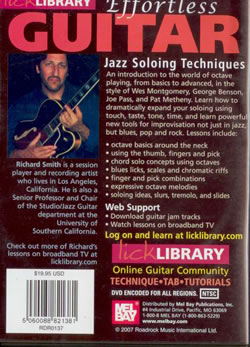
 So here is where knowing a few scales would be a help. Having a good scale reference book is key.
Richards wants us to practice the octave shapes he shows across various scales, major & minor, pentatonic major and pentatonic minor mostly.
These are the minimum scales you absolutely must learn and some would rightly say you need more. The major scale is also known as the Ionian scale and is the mother of all scales and modes in western music.
Richard is skipping from string to string too like he knows his scales really well! Fancy that! Still its not that hard to finger but does take a bit of practice to muffle the middle note and get a nice sound.
Richard stresses "Attitude" or "tude" as one of the five T's: Touch, Taste, Tone, Tuning, Technique, 'Tude. He leaves technique out so I added it myself. I guess that could go under touch.
We then move onto an area related to octaves in that they are also intervals only now instead of unison notes we are talking about sixths and double stops. He can use sixths every place he see a melody note. I grab my Gibson ES-175 guitar for this part. I like sixths and they are everywhere too. Incidentally, for a far more extensive lesson on 6ths I recommend this lesson Mastering Fret Board Harmony. Any way Richard shows us some cool things we can do with sixths to make smooth jazz type melodies. Then he talks Thumb technique, breathy vs dug in. Then he shows us how to play octaves with an added third by changing the octaves fingering. This give you a fatter sound. So far we have been in Am. Now we move to Fm which is more of a jazz key.
Anyway I don't want to give the game away further. I feel that this guitar lesson thus far, and the remaining, is a real nice introduction to playing octaves, 6ths, 3ds and other techniques in a smooth-jazz solo guitar manner.
There is nothing particularly fast or technically challenging here that a student with a smattering of scale knowledge cant put to practical use with a little effort. Unlike other genres you don't need all that many effect pedals or sustain up the wazoo to get sounding like this style. A nice jazz guitar would help if you wanted to get serious but even an an acoustic guitar would be close enough to learn most of the stuff on this guitar lesson. My 350$ Fender Champ XD tube amp has a setting called jazz guitar and it sounds great. It also offers a huge range of other tube sounds from blues to rock to metal with effects. This is the best tube amp out there for the price in my opinion. Also recommended guitar lessons from Richard Smith: Rhythm Guitar Styles & Techniques ( I plug this one p1) and Smooth Jazz Techniques.
If you hear a voice within you say “you cannot paint,” then by all means paint and that voice will be silenced. – Vincent Van Gogh